Popular Now






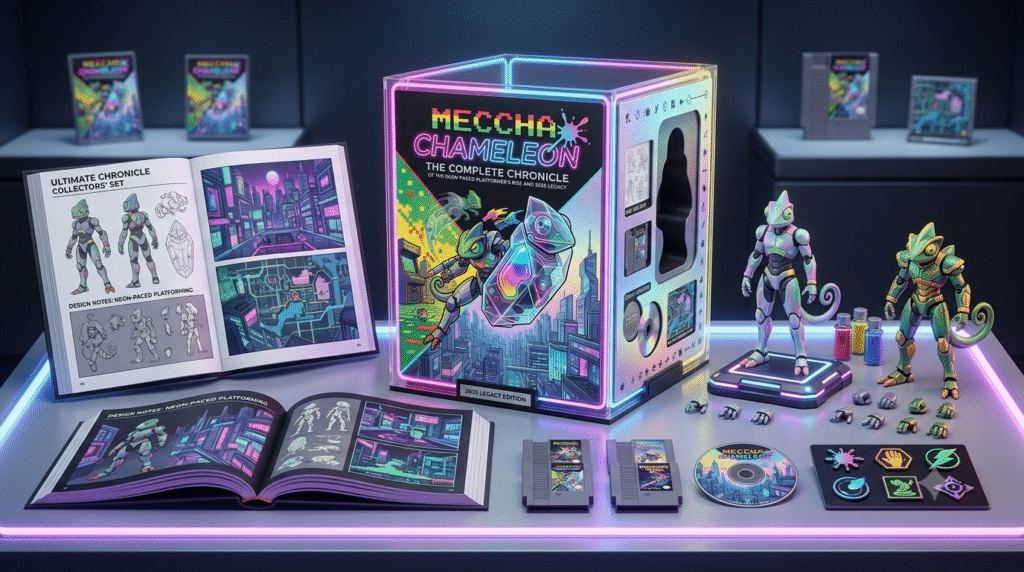
There is something special about a game that does not need an enormous world, hundreds of characters, or a complicated story to keep you playing. Sometimes, all it takes is a clever idea, colorful visuals, responsive controls, and that satisfying feeling of getting better every time you try again. Meccha Chameleon fits neatly into that category.
At first, the game may look like a simple, colorful platforming adventure. Spend a little more time with it, however, and its appeal becomes much easier to understand. Fast movement, vibrant environments, unpredictable challenges, and the distinctive chameleon-inspired gameplay come together to create an experience that feels playful while still giving players plenty of reasons to improve.
As gaming continues to evolve in 2026, games like Meccha Chameleon remind us why straightforward gameplay can still be incredibly effective. You do not always need complexity to create something memorable. Sometimes, the best games are the ones that give you a simple objective and make you think, “Just one more attempt.”
A Small Idea With a Big Personality
The identity of Meccha Chameleon begins with its unusual central character. The chameleon is not simply there to make the game look cute. Its ability to adapt to its surroundings fits naturally into the gameplay concept.
That idea of adaptation is what gives the game its personality.
Players are encouraged to pay attention to their surroundings rather than simply running from one side of the screen to the other. Colors, obstacles, platforms, enemies, and environmental hazards can all become part of the challenge.
This creates an interesting relationship between the player and the game world. You are not just controlling a character; you are constantly observing, reacting, and deciding what to do next.
And that is where the fun begins.
The First Few Minutes
The opening experience is important in any platformer. If the controls feel awkward or the mechanics are poorly explained, players can lose interest quickly.
Meccha Chameleon takes a more welcoming approach. The early gameplay gives players an opportunity to understand how movement works before gradually introducing more demanding situations.
You learn through playing.
Jumping becomes more natural. Movement becomes faster. You begin to recognize patterns. Eventually, actions that initially required concentration become almost automatic.
That learning curve is one of the most enjoyable parts of the experience. There is a noticeable difference between how you play your first few attempts and how you play after spending time with the game.
The Neon-Paced Gameplay
The phrase “neon-paced” perfectly captures the energetic atmosphere surrounding Meccha Chameleon. The game feels lively from the moment you begin moving.
Bright colors and fast-paced action work together to create a sense of momentum. Even when you are simply navigating a section of a level, there is usually something demanding your attention.
Maybe a platform is moving.
Maybe an obstacle is approaching.
Maybe an enemy is positioned exactly where you planned to land.
Maybe the safest route is not the fastest one.
These little decisions make the game more engaging than a basic run-and-jump experience.
The best moments often happen when you react successfully to something that initially seemed impossible. You make a quick movement, avoid an obstacle by a fraction of a second, land safely, and continue forward.
That tiny moment of success can be surprisingly satisfying.
Learning From Failure
One of the strongest qualities of a good platformer is its ability to make failure feel useful.
Meccha Chameleon benefits from this philosophy.
You will probably fall.
You will probably miss jumps.
You will probably take a wrong route.
And yes, there may be moments when you wonder why you attempted a particular move in the first place.
But failure is rarely the end of the experience. Instead, it becomes information.
You learn where the danger is. You discover how an obstacle moves. You understand when to jump. You find a better route.
Then you try again.
The second attempt is different because you are different. You now know something you did not know thirty seconds earlier.
That simple loop — attempt, fail, learn, improve, succeed — is one of the oldest and most effective formulas in gaming.
Level Design That Encourages Exploration
A platformer can become repetitive very quickly if every level follows exactly the same formula.
Meccha Chameleon avoids that feeling by making its environments feel varied and unpredictable. Different sections can emphasize different skills, forcing players to adjust their approach.
Some areas may reward speed.
Others require careful movement.
Some encourage exploration.
Others test reflexes.
This variation is important because it prevents players from relying on a single strategy for the entire game.
Just when you become comfortable with one style of play, the game gives you another situation to solve.
That constant adjustment fits perfectly with the chameleon theme.
More Than Just Getting to the Finish Line
Finishing a level is satisfying, but Meccha Chameleon can offer players reasons to look beyond simply reaching the end.
Exploration can reveal hidden areas, collectibles, alternative routes, or small details that might be missed during a fast playthrough.
This creates two different ways to experience the game.
One player might simply want to complete every stage and see what happens next. Another might replay the same level repeatedly, searching for every secret and trying to improve their performance.
Neither approach is wrong.
That flexibility gives the game additional replay value.
Why the Visual Style Matters
A game’s visual design can have a huge impact on how it feels to play.
Meccha Chameleon uses bright, energetic imagery to complement its fast-paced gameplay. The colorful presentation makes the game immediately recognizable and helps separate it from more traditional platformers.
The visual style also supports the game’s playful personality.
There is a sense that the game does not take itself too seriously. It wants players to have fun, experiment, make mistakes, and keep moving.
That attitude is refreshing.
In an industry where many games compete through realism and cinematic presentation, a stylized game can stand out simply by embracing its own identity.
Sound and Atmosphere
Visuals may grab attention, but sound helps maintain immersion.
Energetic music can make fast sections feel even faster, while sound effects provide immediate feedback when something happens on screen.
A successful jump feels more satisfying when the audio responds to it.
Collecting something feels more rewarding when there is a distinct sound.
Taking damage feels more noticeable when the game immediately communicates that mistake.
These details may seem small individually, but together they contribute to the overall polish of the experience.
The Difficulty Curve
One of the biggest challenges for platform developers is creating difficulty that feels fair.
Nobody wants a game that is completely effortless. At the same time, constantly punishing the player can turn entertainment into frustration.
Meccha Chameleon works best when it allows difficulty to grow alongside the player’s abilities.
Early sections help establish confidence. Later challenges test that confidence.
The result is a gradual transition from “I think I understand this” to “Okay, now I really need to concentrate.”
That feeling is exactly what many platformer fans are looking for.
The Appeal of Repetition
Normally, repeating the same level might sound boring.
In a skill-based platformer, repetition can actually become one of the best parts.
The first time you enter a difficult section, you are reacting.
The fifth time, you are anticipating.
The tenth time, you may be moving almost automatically.
This transformation is what makes replaying a difficult level enjoyable. You are not simply repeating the same experience; you are measuring your own improvement.
Meccha Chameleon benefits from that feeling of mastery.
A Game for Short Sessions or Long Adventures
Another advantage of this type of game is flexibility.
You do not necessarily need to dedicate an entire evening to it. You can play a few stages during a short break and return later.
At the same time, players who become invested can spend much longer sessions trying to master difficult sections and discover everything the game has to offer.
That makes Meccha Chameleon suitable for different kinds of players.
Casual players can enjoy it without feeling overwhelmed.
Platformer enthusiasts can focus on improving their skills.
Completionists can explore every corner.
Competitive-minded players can chase better times and cleaner runs.
The 2026 Perspective
Looking at Meccha Chameleon from a 2026 perspective makes its straightforward design particularly interesting.
Modern gaming is filled with enormous open worlds, live-service systems, complex progression mechanics, and games designed to keep players engaged for hundreds of hours.
Meccha Chameleon represents a different philosophy.
It focuses attention on the immediate experience.
Move.
React.
Adapt.
Try again.
Improve.
That simplicity can actually feel refreshing.
There is something satisfying about opening a game and immediately knowing what you are supposed to do while still having enough depth to make mastery difficult.
Why the Game Can Stay Memorable
Games are remembered for different reasons.
Some are remembered because of their stories.
Others are remembered for characters, music, multiplayer moments, or groundbreaking graphics.
Meccha Chameleon has another advantage: personality.
The combination of a memorable protagonist, colorful presentation, fast movement, and adaptable gameplay gives it an identity that is easy to recognize.
The game does not need to imitate every major release to be successful. Its appeal comes from doing its own thing.
And that is often how cult favorites begin.
The Community Factor
A game’s long-term life is rarely determined only by its original release.
Players share discoveries.
They post gameplay clips.
They discuss difficult sections.
They create guides.
They compare strategies.
They challenge friends.
A game with mechanics that are easy to understand but difficult to master is particularly well suited to this kind of community interaction.
Someone discovering a shortcut can immediately become the person everyone else asks for advice.
Someone mastering a difficult sequence can inspire others to attempt it.
That shared process of learning can keep a game alive long after the initial excitement has disappeared.
What Makes Meccha Chameleon Different?
Ultimately, it comes down to balance.
The game is colorful without relying entirely on visuals.
It is challenging without needing to be brutally difficult.
It is simple enough to understand but offers enough depth to reward practice.
And most importantly, it feels like it has its own personality.
That combination is harder to achieve than it sounds.
A game can have excellent graphics and still feel forgettable. Another can have hundreds of features but fail to create a satisfying gameplay loop.
Meccha Chameleon takes a more focused approach.
It builds around its central idea and lets the gameplay carry the experience.
Final Thoughts
Meccha Chameleon is a reminder that great games do not always need to be enormous.
Sometimes, a memorable character, a creative mechanic, colorful environments, and responsive controls are enough to create something players genuinely enjoy.
Its biggest strength is the way it encourages adaptation. Every mistake teaches something. Every successful attempt builds confidence. Every new level asks players to react to a slightly different challenge.
That creates a satisfying relationship between player and game.
You start by learning how to control the chameleon.
Then you learn how to understand the environment.
Eventually, you begin anticipating what the game is going to throw at you.
And that is when the experience becomes truly enjoyable.
As we look at its place in the gaming landscape of 2026, Meccha Chameleon stands as an example of why focused, personality-driven platformers still have a place in modern gaming. It does not need to overwhelm players with endless systems. Instead, it gives them something much simpler: a colorful world, a memorable character, challenging moments, and a reason to try again.
Sometimes, that is all a great game really needs.
And if the goal is to create a platformer that players remember not because it was the biggest game they played, but because it was one of the most enjoyable, Meccha Chameleon has plenty going for it.